Niacin
Vitamin B3 · 20 mgOne of only two ingredients with its own declared amount. The body converts niacin into NAD, a coenzyme sitting at the centre of how a man’s cells release energy from food.
Read more
Eight ingredients across three categories, each with a page setting out what it is, why a formulator reaches for it, and exactly where the evidence stops.
Two nutrients, two amino acid components, four botanical extracts.
Serving directions are on the current product label.
Every ingredient is named rather than hidden behind a blend title.
Subject to the seller’s published refund terms.
One of only two ingredients with its own declared amount. The body converts niacin into NAD, a coenzyme sitting at the centre of how a man’s cells release energy from food.
Read moreThe second declared amount. An essential mineral involved in immune function, wound healing and the hormone pathways behind male reproductive health.
Read moreA precursor to nitric oxide, the compound that signals blood vessels to relax. The most developed circulation research on this panel sits behind this ingredient.
Read moreMoves long-chain fatty acids into cells to be burned for fuel — a genuine mechanism with a substantial literature behind it.
Read moreMaritime pine bark, a source of proanthocyanidins studied for antioxidant activity and for effects on the lining of blood vessels.
Read moreAn Andean root with centuries of traditional use and a growing set of small human trials around energy, stamina and male vitality.
Read moreA source of resveratrol and related polyphenols, sitting alongside pine bark on the antioxidant and circulatory side of the formula.
Read moreThree stigmas per flower, picked by hand — the most expensive botanical here, with a research record built around mood and general wellbeing.
Read moreThe label specifies zinc oxide, and naming the form is better disclosure than many labels manage.
Per the NIH Office of Dietary Supplements, absorption from zinc oxide runs at roughly 50 per cent, against approximately 61 per cent for zinc citrate or gluconate. It is the least well absorbed of the common supplement forms.
That is not a problem so much as context: it is worth knowing what on a label translates to in practice, and it is the kind of detail that only becomes visible when a brand names the form rather than writing “zinc” and leaving it there.
This is the single most practical thing to know before ordering, and it is a naming problem rather than an accusation against any product.
At least three separate storefronts sell something different under this name. The one described on this site is a capsule containing niacin, zinc, L-citrulline, L-carnitine, pine bark, maca root, grape skin and saffron stigmas, taken once daily. A second domain sells a gummy built around Tongkat Ali, maca, Panax ginseng and ashwagandha — a different format and a different formula entirely. A third lists yet another ingredient set, around Tongkat Ali, maca, inosine and oat straw.
There is also a reformulation in the mix. An older version ran to fourteen ingredients — epimedium, hawthorn, muira puama, damiana, ginseng, tribulus, ginkgo, saw palmetto and others — taken the label serving daily. That is not what is on the shelf now. If a review or video you have seen describes a different ingredient list, it is describing a different product or an older one.
What to do about it takes ten seconds. Confirm the checkout URL before entering payment details, and compare the ingredient panel on your order confirmation against the panel published on this site. If they do not match, you have ordered something else.
The eight ingredients are genuine subjects of published nutritional research. L-citrulline has the most developed circulation literature of anything on the panel. L-carnitine has a substantial history in fatty-acid transport and energy metabolism. Niacin's role in NAD production is textbook biochemistry. Zinc's involvement in hormone metabolism is well established.
None of that is evidence about this product. That research examines single ingredients at their own doses. No finished-product clinical trial on Alpha Rock has been published, and no independent laboratory testing of the finished product was located.
The research is a reason to consider the formula. It is not a prediction of what the formula will do for you, particularly when several of the eight ingredients sit inside a blend that does not publish its own breakdown.
The NIH Office of Dietary Supplements publishes plain-language fact sheets on zinc, niacin and exercise-related supplements if you want to read the underlying material yourself. Their inclusion here does not indicate that any organisation named endorses, recommends or is affiliated with Alpha Rock.
Related reading: the benefit areas, how the formula is designed to work, the journal, and the product overview.

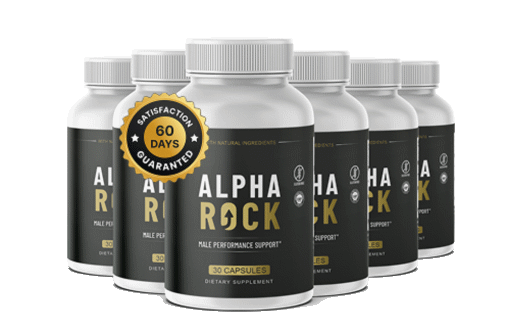
Every order is covered by a 60-day satisfaction window. Because the formula is built for cumulative use rather than a same-day effect, that is a sensible length of time to judge it in.
The start date differs between the brand's own documents. Its Refund Policy and sales page describe the window as running from the original purchase date; its Terms of Service describes it as running from the delivery date. With shipping quoted at 3 to 10 business days, that gap can exceed a week. Get the applicable date confirmed in writing before you rely on it.
A daily, stimulant-free male performance support capsule with a panel that matches its label, sold with a 60-day satisfaction window. Read the formula page first — it sets out what the label confirms and what it leaves open.